APP STORE RISK CONTROL

Recent iOS Risk Control Changes

Many teams feel that App Store review suddenly became harder. The practical way back to a predictable approval rate is not to complain — it is to convert the change into repeatable signals: what gets amplified, what evidence reviewers are missing, and how to make your submission verifiable in minutes.

Get Expert AdviceSee Risk Control Checklist

Repeatable changes you can actually observe

These are not rumors. You can see them in follow-up questions, second rejections, and how review time changes when evidence is missing.

01 Evidence needs to be specific

A generic “fixed” statement used to pass sometimes. Now reviewers often need a test account, steps, and expected results. Without them, validation stalls.

02 Metadata consistency matters more

Titles, screenshots, subscription text, permission disclosures, and in-app behavior must match. Payments, subscriptions, external links, and login flows are the highest-friction areas.

03 Account profile risk is more sensitive

New accounts, frequent submissions, frequent organization changes, and frequent payment strategy changes often raise the chance of heightened review.

04 The review path must be short

Reviewers won’t explore deeply. If the key value requires too many steps, a slow onboarding flow, or hidden entry points, it often becomes “not verifiable”.

05 External redirects are scrutinized

Any path that takes users out of the app — especially related to login, payments, or downloads — is more likely to be questioned and must be justified clearly.

06 Privacy and permissions are treated as a system

It’s not only whether you have a policy. It’s whether pop-ups, disclosures, trigger timing, and actual usage match. Gaps get amplified quickly.

Visual breakdown: signal stack and evidence pack

Share these with your team to align on what to prepare — instead of guessing what review “really wants”.

iOS risk control signal stack diagram
Figure 1: Signal stack. Higher layers are about trust and consistency. If account/profile signals and evidence are weak, even compliant features can still face friction.
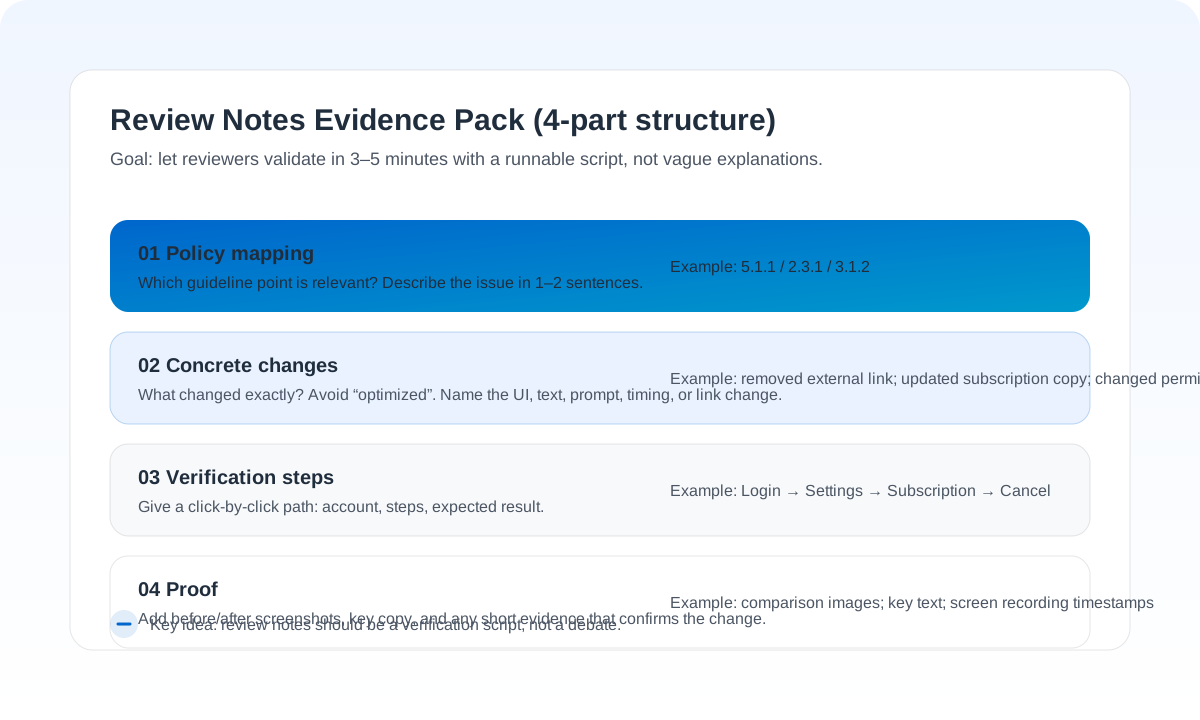
review evidence pack structure diagram
Figure 2: Evidence pack structure. Break review notes into four parts: policy mapping, concrete changes, verification steps, and proof. This matches how reviewers validate.

Key Takeaways

The recent shift is not that policies suddenly multiplied. The shift is that review relies more on verifiable evidence to make decisions: who you are (account profile risk), whether your claims are true (evidence), and whether users might be misled (flow and disclosure consistency). This is why many technically solid builds still get stuck — reviewers simply cannot validate what you described within limited time.

If you want approval rate to be manageable, focus on two outcomes. First, make your core flow a short, verifiable path. Second, write review notes like a runnable script so reviewers can confirm your fixes in 3–5 minutes. In most cases, doing these two things reduces risk-control pressure significantly.

  • Fix verifiability before adding explanations.
  • Treat risk control as “trust engineering”, not last-minute copy edits.
  • Avoid changing organization info, payments, metadata, and permissions all at once.

Hypotheses (not official policy)

These are trend-level hypotheses to help you plan. They are not arguments to use against reviewers. Execution should still align with official policies and verifiable evidence.

  • Similarity and linkage detection will keep strengthening across apps under the same account.
  • Payments and subscriptions remain high-pressure review areas due to user harm risk.
  • External redirects will be harder to justify when they are tied to key actions.
  • Privacy and permissions will continue to be validated as a combined system.
  • Clear evidence packs will matter even more as a shortcut to fast validation.

12-minute pre-submission checklist

  • Test account works reliably and covers the core flow without extra verification steps.
  • The core value can be validated within 3 minutes with minimal onboarding friction.
  • Payment/subscription entry points, pricing, trial, and cancellation text match the store listing exactly.
  • Privacy policy, permission prompts, and trigger timing match real behavior.
  • Any “leave the app” action is justified and constrained with clear user expectations.
  • Review notes follow the four-part structure: policy mapping, changes, steps, proof.

FAQ

Why does iOS review feel less like "policy" and more like "trust" now?+
Many rejections come from inconsistencies across account behavior, metadata, privacy disclosures, and verification evidence. Reviewers need repeatable proof fast.
What exactly counts as verification evidence?+
A working test account, reproducible steps, expected results, before/after comparisons, and clear subscription, pricing, and permission explanations.
Why did a similar build pass before but gets questioned now?+
Risk control evolves. Past approval is not a permanent pass, especially after frequent changes to metadata, payments, permissions, or external links.
How can new accounts reduce the chance of heightened review?+
Start smaller, keep a slower change cadence, and make review notes a runnable script. Focus on verifiability first, not lengthy explanations.
Are the insights here official?+
No. They are patterns seen across projects to help manage risk. Always align execution with official policies and verifiable evidence.